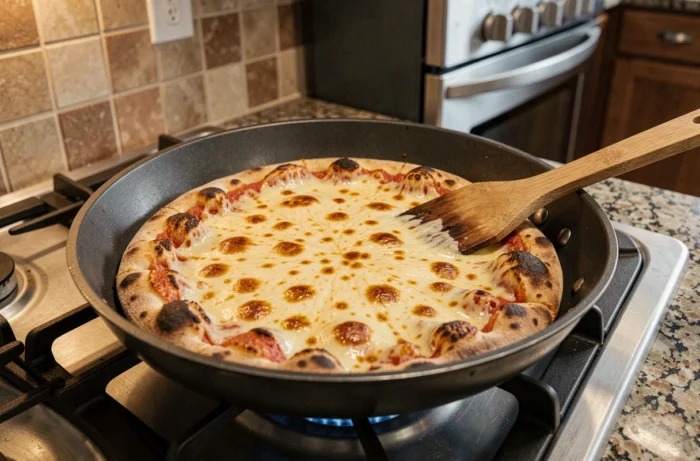
Cooking a frozen pizza in a frying pan doesn’t follow the same rules as cooking it in an oven. The instructions printed on the packaging are for a preheated oven, not a surface that transfers heat through direct contact. Conduction changes everything: the bottom cooks much faster than the top, and the toppings can remain cold while the crust turns black. Understanding this difference in how heat behaves makes it easier to adapt your method.
Pan temperature and coating: how they affect cooking
Your choice of pan determines how much control you have. A cast-iron pan distributes heat more evenly than a thin aluminum pan, reducing the risk of a localized hot spot beneath the center of the pizza.
Nonstick pans come with a specific caveat. The BfR (German Federal Institute for Risk Assessment), as cited by Poeler.fr, recommends not leaving a nonstick pan empty on the heat for too long. Excessive preheating can damage the coating and cause a sudden temperature spike that’s difficult to control when the pizza comes into contact with the surface.
| Pan type | Heat distribution | Preheating while empty | Effect on the crust |
|---|---|---|---|
| Cast iron | Even | Acceptable (no delicate coating) | Even, golden crust |
| Nonstick (Teflon, ceramic) | Varies depending on thickness | Keep to a minimum (risk of overheating the coating) | Quick browning; needs monitoring |
| Heavy-gauge stainless steel | Good with a bonded base | Acceptable | May stick without oil |
Fat serves two purposes. A drizzle of olive oil improves heat transfer between the crust and the pan and helps it brown. With a stainless-steel pan, this step is almost essential to prevent the crust from sticking.
Before adding the pizza, simply cook a frozen pizza in a frying pan over low to medium heat—never high. This gives the heat time to pass through the crust without charring the base.
Thick-crust or thin-crust frozen pizza: adjust the cooking time to the toppings
Not all frozen pizzas cook the same way in a frying pan. The thickness of the crust and the amount of toppings can dramatically change how long it takes for the center to reach a safe, satisfying temperature.
A thin crust can brown in just a few minutes, while a thicker or heavily topped pizza needs considerably longer to heat through. This is the main reason things go wrong: the bottom burns while the cheese is barely warm.
Using a lid in place of an oven dome
A lid turns the pan into a semi-enclosed cooking space. Trapped steam and reflected heat warm the toppings from above, partly making up for the lack of an oven’s top heating element.
- Cover the pan as soon as you add the pizza and cook over low to medium heat. This creates a steaming effect that melts the cheese without overcooking the base
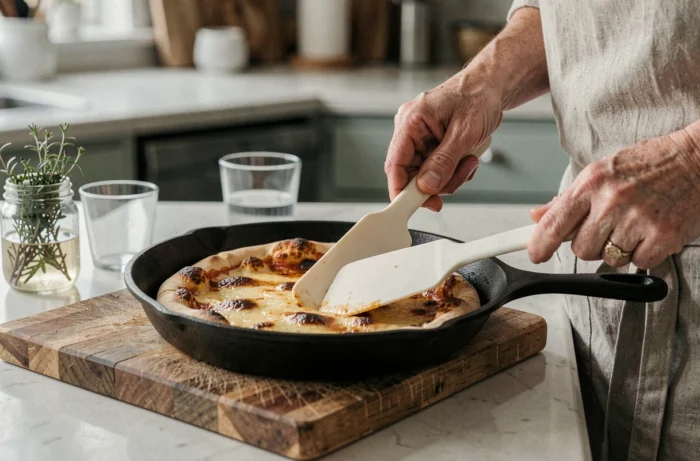
- Lift the lid regularly to check the color of the underside (slide a spatula under the edge of the crust)
- Remove the lid for the final minute if the crust seems soft, allowing moisture to escape so it can crisp up
There’s no universal cooking time you can set in advance. A thin margherita will be ready well before a thick pizza topped with vegetables and meat. Checking the underside and seeing whether the cheese has melted are the only reliable indicators.
Cutting the pizza before cooking: a technique that changes the result
Several sources recommend cutting a frozen pizza into slices before placing it in the pan. This solves a practical problem: most frozen pizzas are wider than the usable base of a standard pan.
Cutting the pizza while it’s still frozen (after letting it rest at room temperature for about ten minutes to make it easier to cut) into pieces that fit the pan lets you lay them flat without overlapping. Each piece then makes direct contact with the hot surface, helping it cook evenly.
Another benefit: smaller pieces cook through faster. The surface-area-to-thickness ratio is more favorable, and the heat doesn’t have to travel across the full diameter to reach the center of the toppings.
Should you flip the pizza?
Flipping the slices halfway through cooking is a matter of debate. The risk is that the toppings will shift and the cheese will stick to the pan. In practice, using a lid makes flipping unnecessary in most cases. If the underside is golden and the cheese has melted, the pizza is done.
Flipping is only worth considering if the toppings are still cold after several minutes of cooking with the lid on. This can happen with a pan that’s too thin to retain enough ambient heat beneath the lid.
Storage and thawing: what to consider before using the pan
The DGCCRF, as cited by Joybuy, reminds consumers that the cold chain must be maintained regardless of the cooking method. A pizza that has partially thawed and then been refrozen before cooking poses the same food-safety risk, whatever appliance you use.
Leaving the pizza at room temperature for a few minutes before cooking makes it easier to cut and reduces the temperature shock in the pan. But don’t leave it out for more than about ten minutes, especially in hot weather.
Picard’s product information for its Pizza Regina Italia illustrates the point: cooking instructions are specific to each product. Applying an oven cooking time to a frying pan without adjusting it is guesswork. A frying pan is a handy fallback, but it requires more attention than a temperature-controlled oven.
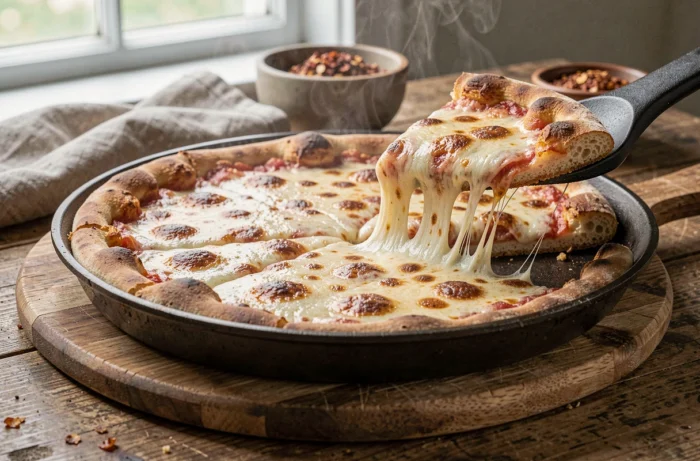
The most reliable way to tell if the pizza is done is to check it visually: the underside should be evenly golden, the cheese melted, and the crust should no longer bend when you lift a slice with a spatula. No timer can replace this direct check.