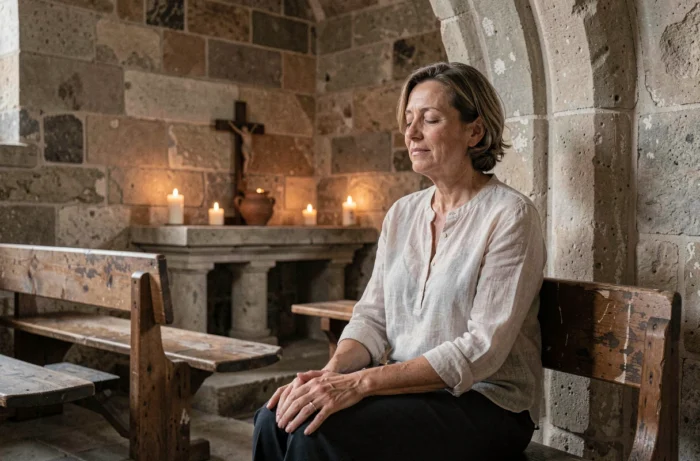
Contacting a monastery to book a stay of a few days is often the first step that holds people back. One doesn’t know whom to write to, how long one can stay, or what one is supposed to do there. However, withdrawing to a convent does not require any religious training or particular commitment: most communities welcome anyone seeking peace, whether they are believers or not.
Accommodation in a monastery: what changes depending on the location and visitor profile
One might imagine a monastic room being the same everywhere. The reality is more nuanced. At the Abbey of Solesmes, for example, men are accommodated within the monastery grounds, in the internal hospitality area, while women and families are housed in homes located in the village. This arrangement directly affects the proximity to community life and the services.
The maximum allowed duration also varies. Solesmes limits the stay to five days for men’s hospitality and eight days for external houses. Other abbeys accept longer retreats, sometimes several weeks, while some only offer weekends. Checking this point at the first contact helps avoid building an unrealistic project.
Before choosing a retreat location, one can withdraw to a convent with Soultzerland to identify monasteries that meet their expectations in terms of duration, mixed accommodation, and type of lodging.
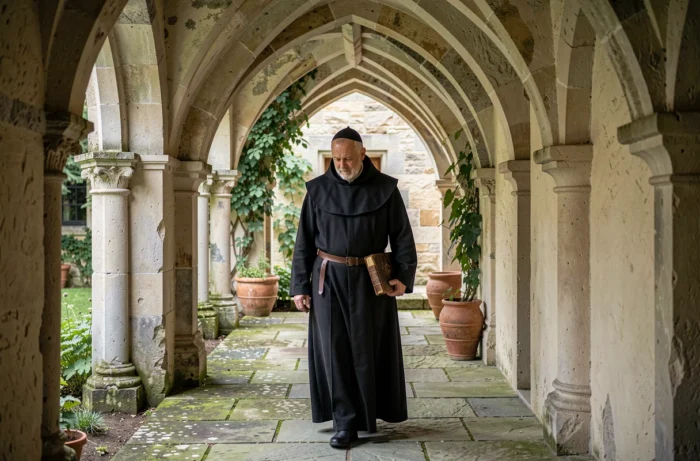
Preparing for a spiritual retreat: concrete steps before departure
The process begins with a letter, an email, or a phone call to the monastery’s hospitality. One specifies the desired dates, the duration of the stay, and, if applicable, whether one wishes to receive spiritual guidance. This last point should be explicitly mentioned: individual guidance is not guaranteed and depends on the availability of monks or nuns.
At Solesmes, a visitor can request to meet a monk for a conversation or confession, but this possibility is presented as conditional. It is better to make this request at the time of booking rather than arriving on-site assuming that an appointment is arranged.
What to pack in your bag
Communities generally provide sheets and basic linen. Meals are taken on-site, often in silence, and their content follows the liturgical rhythm (fast days, partial fasting).
- Simple and comfortable clothing, suitable for indoor life as well as walks within the grounds or the surroundings of the monastery
- A silent alarm clock, as services start early (sometimes before six o’clock) and the use of phones is strongly discouraged, or even prohibited in some places
- A notebook and pen to jot down reflections, as prolonged silence encourages unusual mental activity
- No workbooks or laptops: most monastic accommodations request that screens be set aside
The guiding principle remains simplicity. One comes with the minimum to free oneself from the superfluous, not to reproduce daily habits in a different setting.
Silence and services: the daily rhythm of a retreat in an abbey
The day in a monastery is structured around liturgical services, which mark the hours from dawn to dusk. Retreatants are free to attend or not, but the collective rhythm naturally imposes itself: meals, times of silence, and periods of church opening are aligned with this schedule.
Silence is not an accessory, it is the framework of the stay. It is not a strict prohibition on speaking, but a setting where exchanges are reduced to what is necessary. Meals taken in silence, sometimes accompanied by a reading aloud, mark a clear break from ordinary social habits.
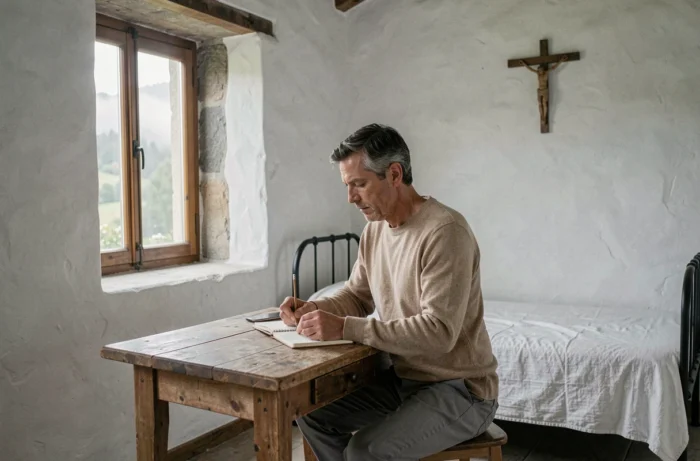
This framework produces concrete effects on a personal level. The first hours are often uncomfortable: the absence of sound and digital stimulation brings to the surface an inner agitation that daily life masks. After a day or two, most retreatants describe a slowing of mental pace and a regained capacity for attention.
Participating in prayer without being a believer
Attending services does not imply adhering to the faith of the community. One can remain seated, listen to the chants, and follow the proceedings without intervening. Monasteries welcome people of all beliefs, and the rule of Saint Benedict, which has founded monastic hospitality since the 6th century, prescribes receiving each guest “as Christ himself,” without prior conditions.
Benefits of a retreat in a convent: what the stay really changes
One often reads lists of generic benefits (stress reduction, reconnection with oneself, letting go). What distinguishes a monastic retreat from a simple peaceful stay is the presence of a community living according to a rule. The retreatant is not alone in a silent house: they are inserted into an ancient, structured collective rhythm that continues with or without them.
This communal dimension provides a framework that secular retreats do not replicate. Fixed schedules, shared meals, and the regularity of services create an external foundation that frees one from the burden of constant decision-making. There is nothing to plan, nothing to organize.
- A real break from digital solicitations, made possible by the absence of Wi-Fi in many monastic accommodations
- A modified relationship with time: the days seem longer, thoughts unfold uninterrupted
- A space for listening, if one requests guidance, with an interlocutor trained in spiritual listening rather than personal performance
The stay does not solve anything by itself, but it offers a perspective that few other settings allow. Returning home after a few days of monastic life often means realizing how much the usual ambient noise occupies mental space without one being aware of it.