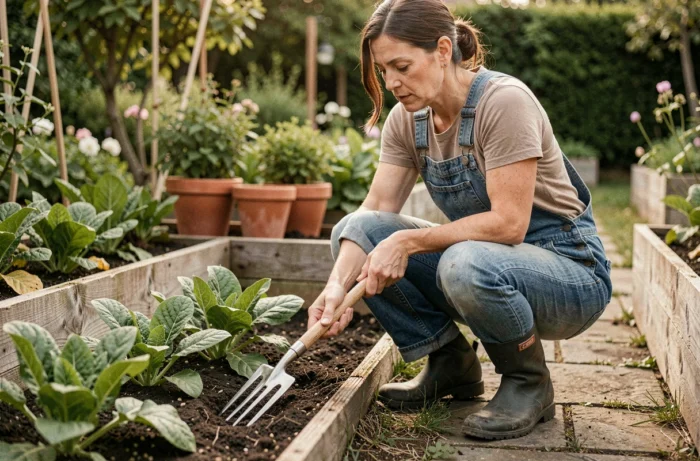
Your spade strains your back and leaves the soil in large compact blocks after each use. The grelinette offers a radically different approach to soil work in the vegetable garden: loosening without turning, aerating without destroying. This tool, invented by André Grelin, relies on a lever principle that preserves underground life while reducing physical effort. However, you need to know when and how to use it, as the grelinette is not suitable for all situations.
Soil Texture and Grelinette: A Tool with Its Limits
Have you noticed that some soils resist the fork more than others? The grelinette works very well in loose, sandy, or loamy soil. Its curved tines penetrate easily and lift the soil without excessive effort.
On very stony ground, the situation changes. The tines get stuck between the stones, the lever movement becomes laborious, and you risk bending the tool. In this case, a flat-tined fork will be more effective for breaking up the first few centimeters before using the grelinette.
Heavily clayey soils present another problem. If you intervene when the soil is waterlogged, you create compact clumps that will take weeks to break apart. The right time is when the soil is dried out, neither saturated with water nor completely dry.
You can easily check this: take a handful of soil and squeeze it. If it forms a ball that crumbles at the touch, the soil is ready for the grelinette. If it sticks or remains in a block, wait a few days.
Specialized resources on grelinette-warrior.com detail the models suited to each type of terrain, preventing an unsuitable purchase for your plot.
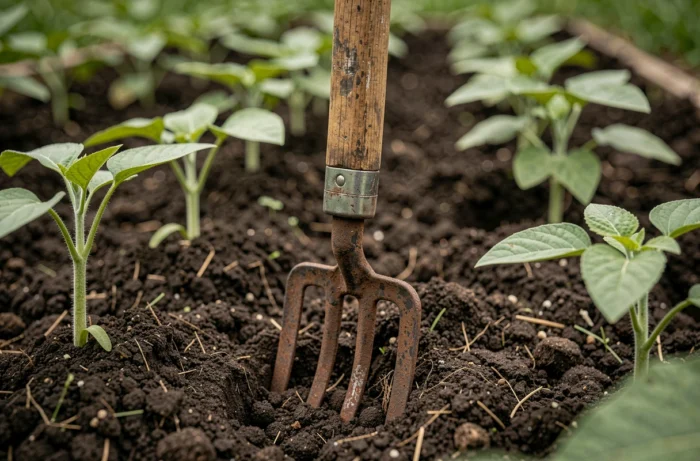
Grelinette and Mulching: Why the Tool Alone Is Not Enough for the Vegetable Garden
Aerating the soil once or twice a year does not guarantee its fertility. Recent agronomic recommendations integrate the grelinette into a set of complementary practices rather than as an isolated solution.
The principle is simple: a permanently covered soil naturally loosens. Mulching (straw, dead leaves, wood chips) protects the surface from compaction caused by rain. Earthworms and microorganisms do the rest by burrowing galleries and decomposing organic matter.
Combining Grelinette, Compost, and Green Manure
The grelinette makes sense when it is part of a cycle. Here is a sequence that works to prepare a cultivation bed in the vegetable garden:
- Mow the green manure (mustard, clover, phacelia) a few weeks before planting, then let it dry on the surface.
- Use the grelinette to loosen the soil to about twenty centimeters, incorporating the plant residues superficially in the top five to ten centimeters.
- Spread a layer of mature compost on the surface, then cover with organic mulch until planting.
Deep burying of green manure should be avoided. The biomass must remain in the biologically active zone of the soil, where bacteria and fungi can transform it into nutrients accessible to plants. The grelinette allows for this superficial burying without turning the horizons.
The Technical Gesture: Three Common Mistakes in the Garden
The grelinette seems intuitive, but a few clumsinesses reduce its effectiveness or damage the tool.
Forcing the Tines In with Your Foot
Unlike the spade, the grelinette is not planted by pressing down with your foot. Its weight and the shape of the tines are sufficient to penetrate properly prepared soil. If you have to force it, the soil is too dry, too compact, or unsuitable for this tool.
Pulling the Handles Too Far Back
The correct movement involves stepping back one or two steps while tilting the handles towards you. Pulling too hard or too far breaks the tines on heavy soils. The lever should lift the soil, not throw it.
Always Working at the Same Depth
At the beginning of the season, a deeper pass loosens the soil after winter. During the growing season, a light pass is sufficient to aerate between the rows of vegetables without disturbing the roots. Adjusting the depth to the context avoids unnecessarily disrupting the soil structure.
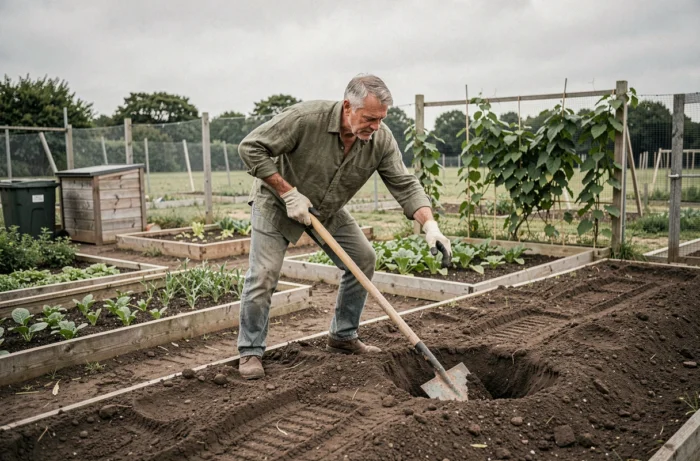
Choosing a Grelinette Suitable for Your Vegetable Garden
The number of tines determines the working width. Three tines are suitable for small spaces and narrow beds. Five tines cover about forty centimeters and fit the majority of family vegetable gardens. Beyond that, models with seven or nine tines are aimed at professional market gardeners.
Have you thought about the shape of the tines? Curved tines facilitate the lever movement in loose soils. Straight tines penetrate better into compact or semi-clay soils. This criterion is often more decisive than the number of tines.
The length of the handles also deserves attention. Handles that are too short force you to bend over, negating the ergonomic advantage of the tool. A good guideline: the handles should reach your hip height when the tines are planted in the soil.
- Loose or sandy soil: curved tines, five-tine model, wooden or fiber handles.
- Clayey or semi-compact soil: straight tines, three or four-tine model to limit effort.
- Large vegetable garden or intensive use: prefer a forged model, more durable over time.
Low-end models made of unforge steel deform quickly, especially in heavy soils. A forged model costs more but lasts for years without loss of performance.
The grelinette does not replace mulching, compost, or green manure. It fits into an ecological gardening method where every action has its place and time. When well chosen and used, it transforms the preparation of the vegetable garden into a precise, quick, and respectful task for the living soil that nourishes your vegetables.