Modern decor is no longer just about a choice of colors or furniture. It now incorporates regulatory constraints, professional reuse channels, and materials whose composition is scrutinized by European standards. Measuring these changes allows us to distinguish sustainable trends from passing fads and to guide design decisions based on verifiable criteria.
Traceability of furniture and digital passport: what’s changing for modern decor
The European regulation ESPR gradually sets requirements for durability, reparability, and recyclability for certain product categories, including furniture. This framework includes the establishment of digital product passports, which will inform consumers about the origin, composition, and end-of-life of a piece of furniture.
For an interior decoration project, this evolution changes the way we assess items. A sofa or coffee table is no longer judged solely on style or price, but also on its traceability information. Brands that anticipate these obligations are already displaying detailed information about their materials and manufacturing processes.
Fans who follow decor with News Déco regularly find analyses on these regulatory changes and their concrete impact on furniture choices.
Second-hand and reuse: comparison between channels for indoor furniture
Second-hand furniture is becoming more professionalized in France. Resource centers, refurbishment platforms, and specialized resellers offer verified or restored pieces, as part of the 2024-2029 specifications for the REP furniture sector. Reuse is no longer just an aesthetic or economic approach: professionals document the origin, condition, and regulatory compliance of recovered items.
An old parquet floor, for example, must be checked before reinstallation to ensure its compliance. This technical rigor distinguishes professional reuse from simple second-hand purchases between individuals.
| Criteria | Resource center / professional refurbishment | Purchase between individuals |
|---|---|---|
| Condition verification | Systematic control, restoration if necessary | Variable, at the buyer’s discretion |
| Origin traceability | Documented (origin, assembly) | Rarely available |
| Regulatory compliance | Verified (current standards) | Not guaranteed |
| Warranty or recourse | Possible depending on the structure | None in general |
| Price | Intermediate | Generally lower |
For a living room or common area, going through a regulated channel reduces the risk of unpleasant surprises regarding the sturdiness or compliance of a vintage piece.
Upholstery fabrics and the end of PFAS: which materials to prioritize
Stain-resistant and water-repellent treatments applied to upholstery fabrics often rely on per- and polyfluoroalkyl substances (PFAS). Their gradual phase-out from the European market is prompting manufacturers to rethink fabric durability. Performance now depends more on the material and weave than on a chemical treatment.
A thick linen or tightly woven cotton naturally resists stains better than a fine chemically treated polyester. This information changes how one chooses a sofa cover, curtains, or cushions for a modern interior.
- Washed linen offers high mechanical resistance and a textured appearance that ages well, without surface treatment.
- Twill cotton, thanks to its dense diagonal weave, limits liquid absorption by its very structure.
- Wool-cotton blends provide natural wrinkle resistance and good durability, suitable for high-traffic areas like the living room.
Checking the composition and type of weave before purchase becomes a more reliable reflex than relying on an “anti-stain” label.
Colors and biophilic design: measurable decor trends
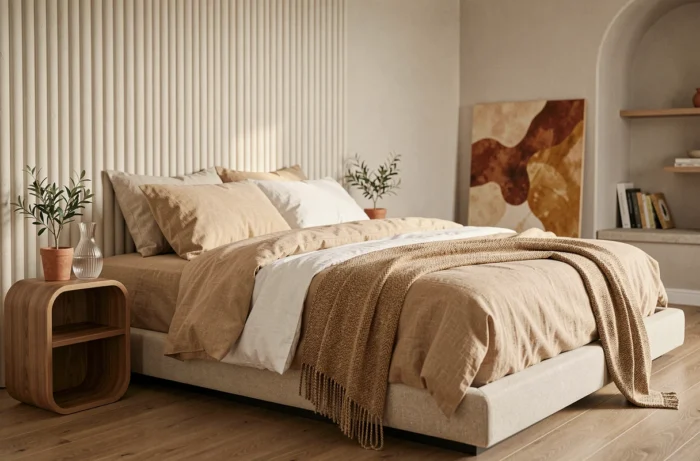
Color trends for interior decoration converge towards organic shades and bright accents used sparingly. However, biophilic design goes beyond the mere presence of plants: it incorporates natural materials (raw wood, stone, plant fibers) and utilizes natural light as a structuring element of the space.
The combination of muted colors in the background (terracotta, sage green, warm beige) with one or two bold accents (mustard yellow, teal) creates a controlled contrast. This approach works well in both small spaces and large living areas.
- Walls in neutral and organic tones to anchor the atmosphere without visually overwhelming the room.
- Furniture or decorative objects in unvarnished wood or rattan to enhance the biophilic dimension.
- One or two textile elements in a bright color to energize the whole without overloading.
A well-thought-out biophilic interior reduces reliance on artificial lighting by maximizing natural light input, which also alters the perception of chosen colors depending on the time of day.
Sustainable decoration and style: balancing without sacrificing aesthetics
Choosing refurbished furniture, PFAS-free textiles, or traceable materials does not mean giving up a strong style. Curved lines, organic shapes, and combinations of raw materials (patinated metal, solid wood, artisanal ceramics) create a modern decorative vocabulary that relies on the intrinsic quality of materials rather than superficial finishes.
Durability becomes a style criterion, not a concession. A solid wood armchair from a resource center can structure a living room with as much character as a new piece, provided its condition and provenance are verified according to current REP sector standards.
The coming years will make this information more accessible through digital passports. The most relevant decor choice today is to prioritize pieces whose history, composition, and expected lifespan can be traced.